
MDOC Release Records Explained
MDOC means the Mississippi Department of Corrections. It manages people serving state sentences in prisons and other placements. It also keeps jurisdiction over some people who have left a prison building. That scope makes the MDOC offender search useful, but it also makes a result easy to misread. A person can be physically outside a prison and still be an MDOC inmate under Earned Release Supervision, or ERS.
State custody is only one layer. Mississippi county sheriffs own local booking and jail-release records. The Federal Bureau of Prisons and immigration authorities use separate systems. A transfer between those systems is not a community release. Start with the authority that owned the sentence or hold. The MDOC search is the right first source for a sentenced state prisoner, while the county directory routes a local-jail inquiry.
The official MDOC landing page shows where the state places its public search tools.

The agency page separates inmate, parolee, records, and supervision routes because each answers a different release question.
Use the MDOC Offender Search
The MDOC offender search accepts first and last name or an MDOC identification number. The number is the best match key when known. Name searches may return similar names, so compare the photograph, demographic details, county of conviction, and sentence data. A missing result is not proof of discharge. Spelling, search scope, a different custody system, or completion of an old sentence may explain it.
- Open the official MDOC inmate search. Enter the MDOC number when available, or use the first and last name.
- Review every likely match. Compare the state number and personal details, not just the name.
- Open the detail record. Read Location, Unit, Location Change Date, sentence rows, and Tentative Release Date together.
- If parole may apply, check the separate parolee search. If neither tool resolves discharge, contact MDOC Records or file a records request.
The official search form shows the two available search routes.
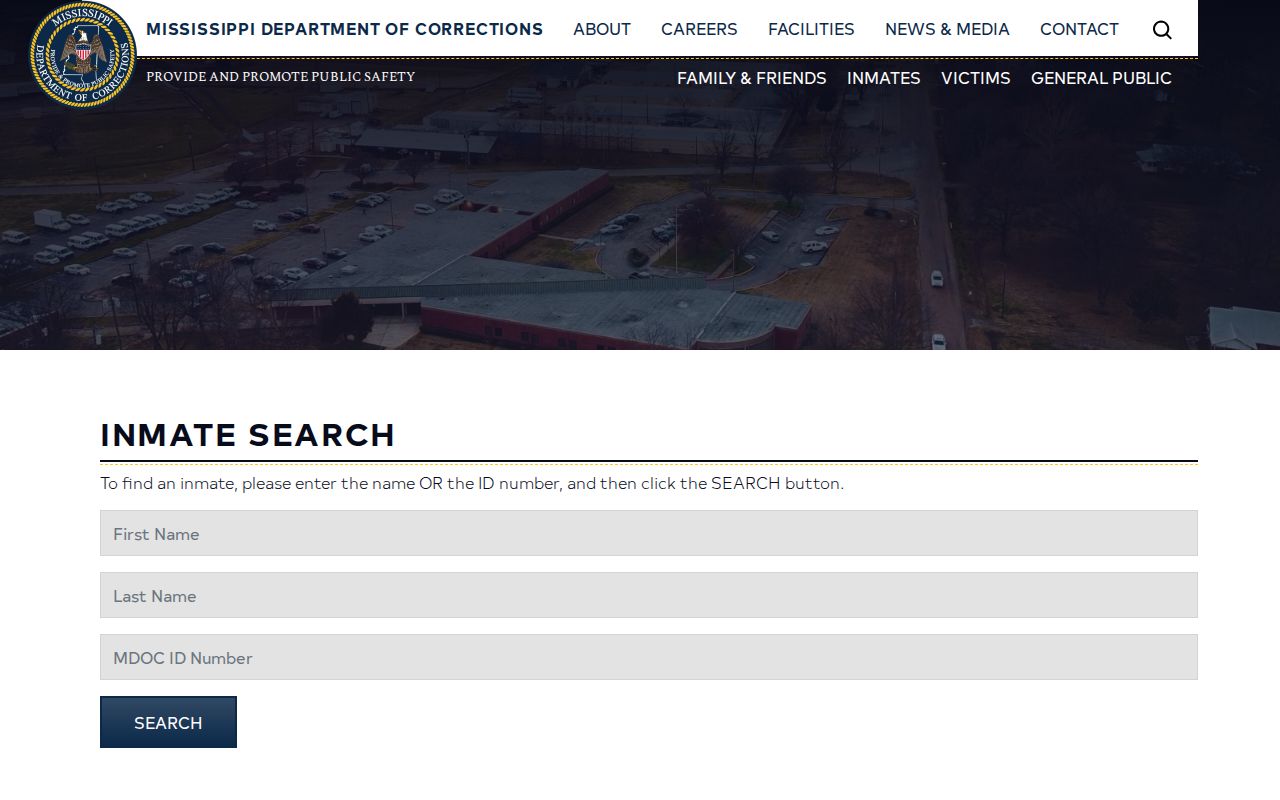
This form has no release-status filter, so careful review of the detail page remains essential.
Note: No current official example with a literal Released or Discharged label was verified, so do not assume that wording will appear.
MDOC Offender Search Fields
An official detail page can show identity, placement, and sentence data in one record. Tentative Release Date is an anticipated date after applicable credits and earned-time changes. It is not a statement that release occurred. Location and Unit may point to a prison, regional facility, or community supervision placement. Location Change Date records movement in MDOC data, but it does not alone prove entry into the community.
| Field | How to Read It |
|---|---|
| MDOC number | State identifier used to separate people with similar names. |
| Location and Unit | Current MDOC placement, including an ERS location when community custody applies. |
| Location Change Date | Date the recorded placement changed, not automatic proof of discharge. |
| Entry Date | Recorded entry into the MDOC term reflected by the profile. |
| Sentence details | Offense, county of conviction, sentence date, length, and related sentence rows. |
| Tentative Release Date | Anticipated date after applicable time calculations, subject to later change. |
The official standard inmate detail demonstrates the field set and its Tentative Release Date label.
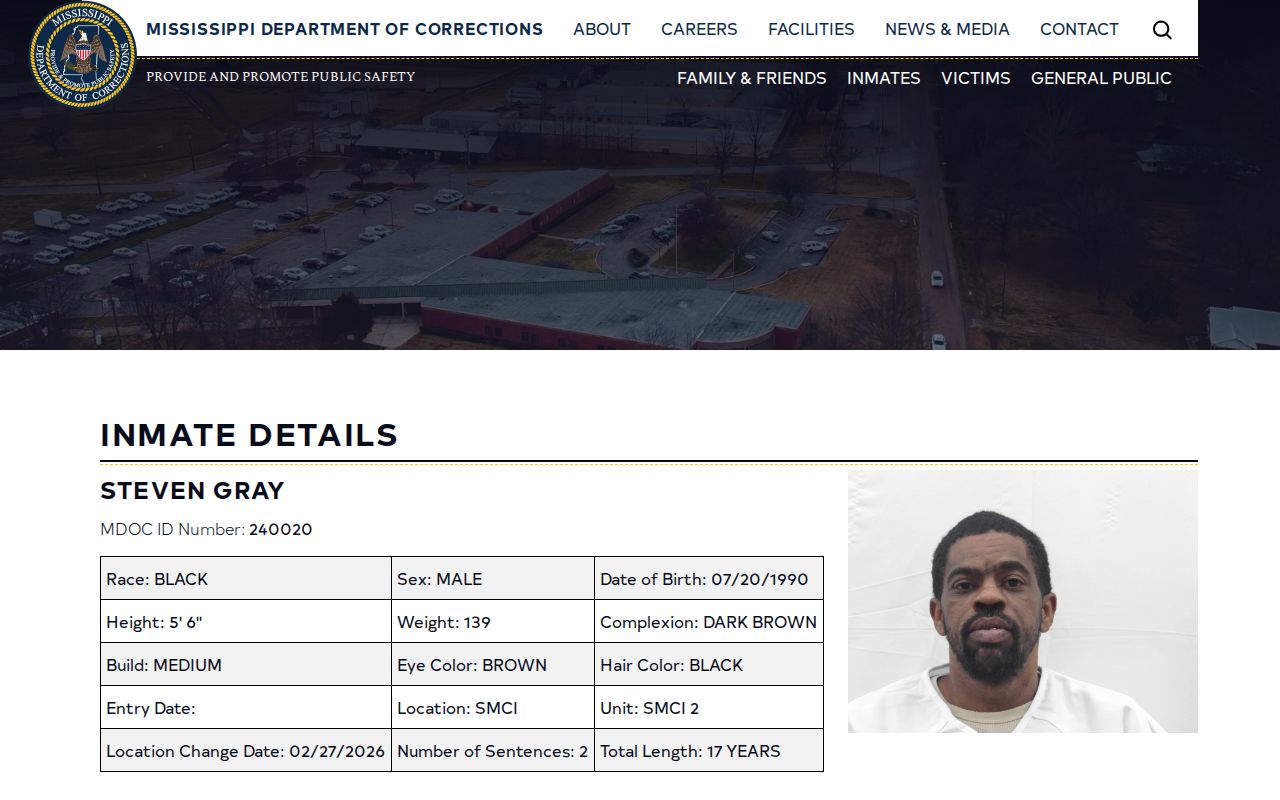
Read the sentence rows with the location fields rather than treating one date as a completed release record.
MDOC Released Inmates on ERS
Mississippi’s search can show physical release without sentence discharge. An official result has listed SOUTH MISSISSIPPI EARNED RELEASE SUPERVISION as the Location and HARRISON ERS as the Unit. Another has shown Central Mississippi ERS and Hinds ERS. These are not ordinary prison housing labels. They mark supervision in the community while MDOC jurisdiction continues.
MDOC’s supervision explanation states that ERS retains inmate status. The person is supervised like a parolee until sentence expiration. Revocation can return the person to confinement, and time on ERS does not reduce the remainder after revocation. Thus, “left the prison” and “discharged from the sentence” are different findings.
The South Mississippi ERS example makes that distinction visible.
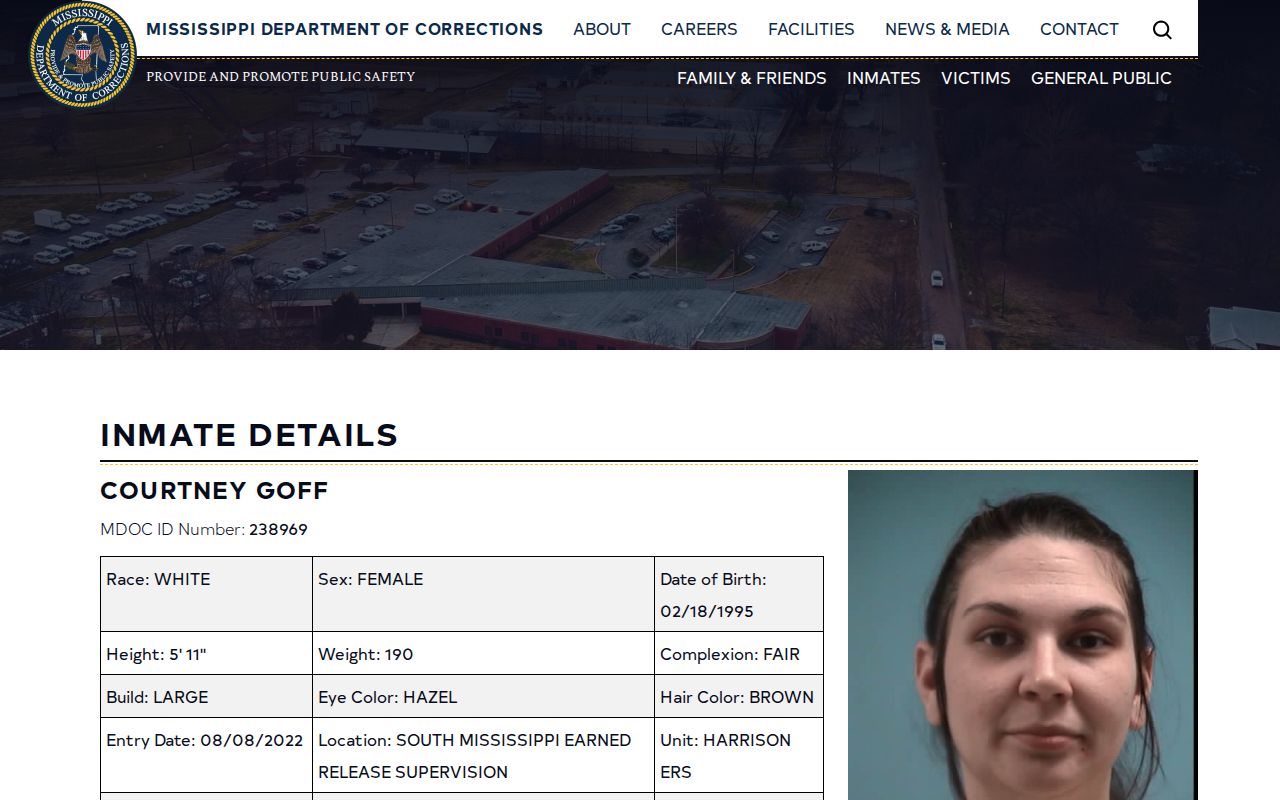
The future tentative date on an ERS record is a strong cue that institutional release did not end MDOC control.
MDOC Release and Discharge Paths
MDOC uses several exit terms. Parole is conditional release granted by the Mississippi State Parole Board after eligibility review. ERS is conditional community placement tied to earned time. A tentative date predicts a possible institutional release after adjustments. Maximum discharge is the expected end without early-release allowances. Conditional medical release transfers an eligible person to Community Corrections under statutory conditions; it is not an ordinary completed discharge.
- Parole
- Conditional release approved and revocable by the State Parole Board.
- Earned Release Supervision
- Community placement under MDOC jurisdiction while inmate status continues.
- Tentative release
- An anticipated date that reflects applicable credits and can change.
- Maximum discharge
- The expected release point without early-release allowances.
MDOC’s FY2023 report counted 5,823 releases. The agency categorized 2,833 as parole, 1,765 as probation, 592 as expiration of sentence, 437 as ERS, 91 as deaths, 54 as other, 48 as house arrest, three as medical release, and none as conditional release. These are MDOC’s own categories. They show why “released” cannot prove that all supervision ended.
Good time affects some state sentences under Section 47-5-138, but its 85/15 shorthand is not universal. Eligibility depends on sentence date, offense, exclusions, conduct, and other law. The detailed calculation belongs on the Mississippi Projected Release page.
Mississippi Prison Release Logistics
MDOC’s release and discharge information gives unusually concrete process details. A case manager tells the inmate the release date and asks about travel plans. Those plans are checked. When bus travel is requested, MDOC may buy a ticket to an in-state destination or the nearest city, but it does not buy out-of-state travel.
MDOC says release processing may take 30 to 45 days and requires a discharge certificate before release. The inmate should keep in touch with the case manager and may relay the plan to family or friends. Account funds are supplied after release, but not in cash. On a transfer, those funds follow the inmate. None of this supports a claim that Mississippi pays standard “gate money.” No uniform state-funded gratuity was verified.
The official release FAQ is the source for the certificate, travel, timing, and account-fund details.

These logistics describe the process, not a guarantee that any public profile will update on the same day.
MDOC Release Trends and Scale
The August 3, 2026 MDOC fact sheet reported 21,823 inmates and 43,323 parolees or probationers within 65,146 active offenders. The supervised group was almost twice the inmate count. That scale matters for an MDOC released-inmate search because many people outside prison remain tied to state supervision rather than appearing as fully discharged.
The July 1, 2026 fact sheet listed 43,153 supervised people and 21,894 inmates. By August 3, the supervised count rose by 170 while the inmate count fell by 71. This is a one-month comparison, not a long-term trend. It still shows that a lower prison count can coincide with a larger supervision count. A complete release check pairs the inmate result with parole, probation, and records channels.
Confirm MDOC Parole After Release
The separate MDOC Parolee Search is the strongest statewide public check for current parole. It accepts first name, last name, MDOC number, city, or county. A result can show the state ID, race, sex, birth date, assigned county, supervising officer, Flat Time Date, and photograph. Flat Time Date is useful context for the sentence, but the profile remains a current supervision tool rather than a complete archive of every past parole period.
A person missing from the parolee search is not automatically discharged. The name may be entered another way. The person could be on probation, ERS, or under a different authority. Supervision may also have ended outside the public tool’s current scope. No separate statewide public probationer locator was verified. For probation, route the question to the MDOC office in the county of assignment and the sentencing court.
The court file can document a sentence, probation order, revocation, or later order. It may not establish the exact day that physical custody ended. Likewise, Mississippi SAVIN can send an escape or abscond supervision notice and a return-to-custody notice when a participating agency updates its record. SAVIN is not a warrant database, and a missing result does not clear a warrant.
When parole status is uncertain, compare the inmate and parolee profiles by MDOC number. Then ask the assigned office or MDOC Records whether supervision remains active and what date or order controls it. This extra check prevents a prison-location change from being mistaken for completed discharge.
MDOC Versus County Release Records
An MDOC record concerns a state sentence. A county jail record concerns local detention, which may include a person awaiting trial, held on bond, serving local time, or waiting for transfer. Someone can disappear from a county roster because of release, transfer to MDOC, movement to another county, federal custody, or an immigration hold. The roster change alone does not identify which event occurred.
| Question | State sentence | County detention |
|---|---|---|
| Primary owner | Mississippi Department of Corrections | County sheriff or regional jail authority |
| First lookup | MDOC offender search | County roster or release record |
| After custody | Check parole, ERS, probation, or discharge | Confirm release versus transfer or another hold |
| Document route | MDOC Records or Legal Division | Local records custodian |
For a county case, use the County Directory to reach the local record owner. A federal inquiry belongs in the BOP locator, and an immigration-detention inquiry belongs with ICE.
Note: A transfer is a custody change, not proof that the person entered the community.
Request MDOC Discharge Records
The public search does not display a discharge certificate. MDOC also does not promise how long a fully discharged offender remains searchable. When online fields do not settle the issue, ask for records sufficient to show the custody-release date, exit type, and sentence-discharge status. Include the full name and MDOC number. A request may also seek any nonexempt discharge certificate and final time computation.
For sentence time, jail credit, and eligibility, MDOC Records lists P.O. Box 24388, Jackson, MS 39225, phone 601-933-2889, and MDOCRecordsDepartment@mdoc.state.ms.us. Public-record requests ordinarily must be written, identify the records, include contact details and a signature, and go to the Public Records Officer, Legal Division, Mississippi Department of Corrections, 301 North Lamar Street, Jackson, MS 39201. The listed fax is 601-359-5735, and the email is legalpublicrecords@mdoc.state.ms.us.
MDOC says it responds within seven working days. If approved, it estimates cost and produces records within 14 working days after the request and payment unless more time is required. Ordinary mechanically copied pages cost $0.15 each. Search, review, redaction, or segregation beyond one hour may be billed at the lowest qualified employee’s rate. Mailing, vendor work, and advance payment may also apply.
The MDOC public-record request portal provides the online submission route.
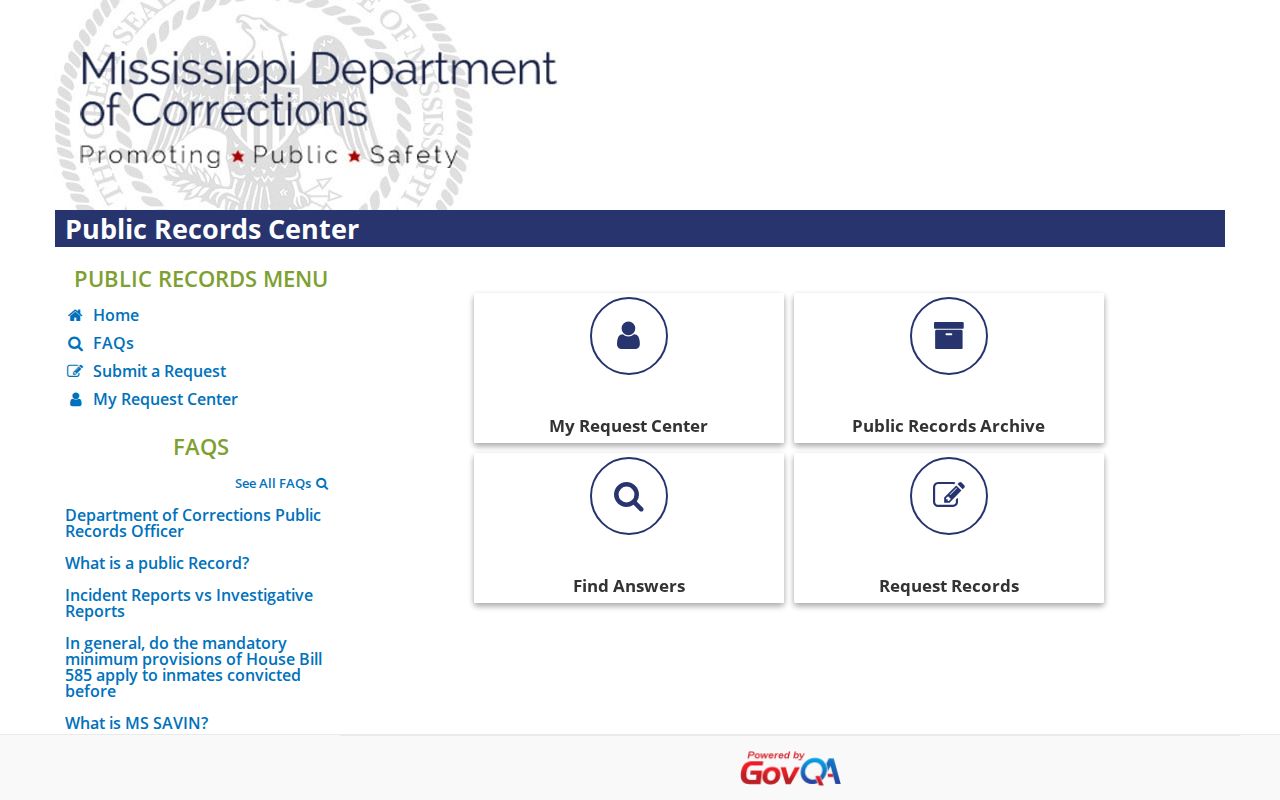
A portal receipt confirms submission, not that a person was released or discharged.
Mississippi’s Public Records Act permits exemptions and protected information. MDOC identifies investigative records, victim information, protected personal material, certain prison records, court-protected records, and parole or probation field-officer records among possible limits. Nonexempt portions should be separated where possible. A written denial should identify its legal basis.
The broader Mississippi Public Records Act appears in Miss. Code Sections 25-61-1 through 25-61-19. Section 25-61-5 makes nonexempt public records subject to reasonable written procedures and requires a written denial to identify the exemption. Section 25-61-7 allows actual-cost charges for search, review, copying, and mailing. Judicial records follow court rules rather than the executive-agency process in every respect.
Medical records follow a different route. MDOC says records for an incarcerated, released, or deceased person require authorization or a court order and go through Medical Compliance. Do not fold a medical request into a general discharge inquiry. Ask only for the custody and sentence documents needed to resolve the release question, then follow any separate authorization rules that apply.
Most important, no official MDOC retention promise was verified for public search results after full discharge. The online tool should never be described as an indefinite archive. Preserve the response from Records when documentary proof matters, and read the exact words on that response rather than assuming that “release,” “discharge certificate,” and “end of supervision” mean the same event.
A narrowly worded request is easier to process than a demand for an entire institutional file. State the time period, identify the person, and list the precise release facts sought. If MDOC says another office owns part of the record, keep that response and send the remaining question to the named custodian. This creates a traceable chain from public search result to agency record without assuming that an absent profile proves anything about past custody.